







How to calculate your Body Mass Index (BMI)
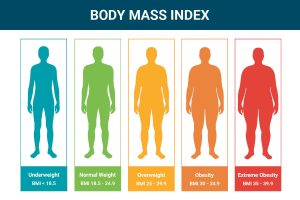
Understanding BMI
By dividing your weight by your height, BMI calculates the range of weight in which you are “underweight,” at a “healthy” point, “overweight,” or “obese” relative to your height. BMI is often used in the medical field to assess a patient’s risk of chronic disease. Please note: your BMI is based only on your weight and does not include your body fat. This index does not take into account fat, muscle, or bone mass.
Calculate your BMI here
Rather than worrying about what the scale says, you can use your height and weight to calculate your body mass index (BMI) to find out what weight range you fall into.
Example: A 183 cm tall man who weighs 107 kg is overweight because his BMI is 32. The healthy weight range for this height is 62 – 84 kg
BMI ranges:
Below 18.5: You are underweight. This could be a sign that you are not eating enough or that you may have an underlying medical condition. Your doctor can help you if you are concerned about your underweight.
18.5 to 24.9: You are at a healthy weight! Keep it up!
25 to 29.9: You are overweight. You probably have some extra fat or a lot of muscle mass. It would be in your best interest to adopt healthy habits such as eating a balanced diet or being more active.
30+: You are obese. You could be in this category for a variety of reasons, so try to make sure you are following a healthy and active lifestyle while eating a balanced diet.

BMI Accuracy:
BMI only takes into account height and weight and places you in a weight range. However, the calculator cannot differentiate between fat and muscle. So if you have a lot of muscle mass (denser than fat), you can easily end up in the overweight or obese category.